ââ⢠What Are Haptic and Optic Forms of Art?

Haptic technology, also known as kinaesthetic communication or 3D bear upon,[1] [2] refers to whatever technology that tin create an experience of touch past applying forces, vibrations, or motions to the user.[3] These technologies tin can exist used to create virtual objects in a figurer simulation, to control virtual objects, and to raise remote control of machines and devices (telerobotics). Haptic devices may incorporate tactile sensors that measure forces exerted past the user on the interface. The word haptic, from the Greek: ἁπτικός (haptikos), means "tactile, pertaining to the sense of touch". Elementary haptic devices are common in the class of game controllers, joysticks, and steering wheels.
Haptic technology facilitates investigation of how the human sense of touch works past allowing the creation of controlled haptic virtual objects. Most researchers distinguish 3 sensory systems related to sense of touch in humans: cutaneous, kinaesthetic and haptic.[4] [5] [vi] All perceptions mediated past cutaneous and kinaesthetic sensibility are referred to as tactual perception. The sense of touch may exist classified as passive and active,[7] and the term "haptic" is often associated with agile touch to communicate or recognize objects.[8]
History [edit]
I of the earliest applications of haptic engineering was in large shipping that use servomechanism systems to operate control surfaces.[nine] In lighter aircraft without servo systems, equally the shipping approached a stall, the aerodynamic buffeting (vibrations) was felt in the pilot's controls. This was a useful warning of a unsafe flight condition. Servo systems tend to be "one-way," meaning external forces applied aerodynamically to the control surfaces are non perceived at the controls, resulting in the lack of this important sensory cue. To accost this, the missing normal forces are simulated with springs and weights. The angle of attack is measured, and as the critical stall point approaches a stick shaker is engaged which simulates the response of a simpler control system. Alternatively, the servo force may exist measured and the bespeak directed to a servo organisation on the control, also known every bit force feedback. Force feedback has been implemented experimentally in some excavators and is useful when excavating mixed fabric such as large rocks embedded in silt or clay. Information technology allows the operator to "experience" and work around unseen obstacles.[x]
In the 1960s, Paul Bach-y-Rita developed a vision substitution organization using a 20x20 array of metal rods that could exist raised and lowered, producing tactile "dots" coordinating to the pixels of a screen. People sitting in a chair equipped with this device could identify pictures from the design of dots poked into their backs.[11]
The first US patent for a tactile telephone was granted to Thomas D. Shannon in 1973.[12] An early tactile man-automobile communication organisation was constructed by A. Michael Noll at Bell Telephone Laboratories, Inc. in the early 1970s[13] and a patent was issued for his invention in 1975.[14]

In 1994, the Aura Interactor belong was developed.[15] The vest is a wearable force-feedback device that monitors an sound signal and uses electromagnetic actuator applied science to convert bass sound waves into vibrations that tin can represent such actions as a dial or kick. The vest plugs into the audio output of a stereo, Tv set, or VCR and the sound indicate is reproduced through a speaker embedded in the belong.

In 1995, Thomas Massie developed the PHANToM (Personal HAptic iNTerface Machinery) system. It used thimble-like receptacles at the end of computerized artillery into which a person's fingers could be inserted, allowing them to "feel" an object on a figurer screen.[16]
In 1995, Norwegian Geir Jensen described a wristwatch haptic device with a skin tap mechanism, termed Tap-in. The wristwatch would connect to a mobile phone via Bluetooth, and tapping-frequency patterns would enable the wearer to respond to callers with selected curt messages.[17]
In 2015, the Apple Watch was launched. It uses skin tap sensing to deliver notifications and alerts from the mobile telephone of the watch wearer.
Types of mechanical bear on sensing [edit]
Human sensing of mechanical loading in the pare is managed by Mechanoreceptors. There are a number of types of mechanoreceptors just those present in the finger pad are typically placed into ii categories. Fast acting (FA) and dull interim (SA). SA mechanoreceptors are sensitive to relatively large stresses and at low frequencies while FA mechanoreceptors are sensitive to smaller stresses at higher frequencies. The result of this is that generally SA sensors can detect textures with amplitudes greater than 200 micrometers and FA sensors can find textures with amplitudes less than 200 micrometers down to virtually 1 micrometer, though some research suggests that FA tin only discover textures smaller than the fingerprint wavelength.[18] FA mechanoreceptors achieve this high resolution of sensing by sensing vibrations produced by friction and an interaction of the fingerprint texture moving over fine surface texture.[xix]
Implementation [edit]
Vibration [edit]
The majority of electronics offering haptic feedback use vibrations, and most use a type of eccentric rotating mass (ERM) actuator, consisting of an unbalanced weight attached to a motor shaft. As the shaft rotates, the spinning of this irregular mass causes the actuator and the attached device to milk shake. Some newer devices, such every bit Apple'due south MacBooks and iPhones featuring the "Taptic Engine", accomplish their vibrations with a linear resonant actuator (LRA), which moves a mass in a reciprocal manner past means of a magnetic vocalisation ringlet, similar to how AC electrical signals are translated into motion in the cone of a loudspeaker. LRAs are capable of quicker response times than ERMs, and thus tin transmit more accurate haptic imagery.[twenty]
Piezoelectric actuators are as well employed to produce vibrations, and offering even more precise motion than LRAs, with less dissonance and in a smaller platform, only require college voltages than do ERMs and LRAs.[21]
Strength feedback [edit]
Force feedback devices use motors to manipulate the movement of an particular held past the user.[22] A mutual use is in motorcar driving video games and simulators, which turn the steering wheel to simulate forces experienced when cornering a real vehicle. Direct-drive wheels, introduced in 2013, are based on servomotors and are the well-nigh high-end, for strength and fidelity, blazon of force feedback racing wheels.
In 2007, Novint released the Falcon, the first consumer 3D bear on device with high resolution three-dimensional force feedback. This immune the haptic simulation of objects, textures, recoil, momentum, and the physical presence of objects in games.[23] [24]
Air vortex rings [edit]
Air vortex rings are donut-shaped air pockets fabricated up of concentrated gusts of air. Focused air vortices tin accept the strength to blow out a candle or disturb papers from a few yards away. Both Microsoft Research (AirWave)[25] and Disney Research (AIREAL)[26] have used air vortices to deliver non-contact haptic feedback.[27]
Ultrasound [edit]
Focused ultrasound beams can exist used to create a localized sense of pressure level on a finger without touching any physical object. The focal point that creates the sensation of pressure is generated by individually controlling the phase and intensity of each transducer in an array of ultrasound transducers. These beams can besides be used to deliver sensations of vibration,[28] and to give users the ability to feel virtual 3D objects.[29]
Another form of tactile feed back results from active touch when a human being scans (runs their finger over a surface) to proceeds information most a surfaces texture. A pregnant amount of data about a surfaces texture on the micro meter scale can be gathered through this action as vibrations resulting from friction and texture activate mechanoreceptors in the man peel. Towards this goal plates tin exist fabricated to vibrate at an ultrasonic frequency which reduces the friction between the plate and skin.[30] [31]
Applications [edit]
Automotive [edit]
With the introduction of large touchscreen control panels in vehicle dashboards, haptic feedback technology is used to provide confirmation of touch commands without needing the driver to take their optics off the road.[32] Boosted contact surfaces, for case the steering wheel or seat, tin as well provide haptic information to the driver, for example, a warning vibration blueprint when close to other vehicles.[33]
Art [edit]
Haptic technologies have been explored in virtual arts, such as sound synthesis or graphic design and blitheness.[34] Haptic applied science was used to heighten existing art pieces in the Tate Sensorium exhibit in 2015.[35] In music creation, Swedish synthesizer manufacturer Teenage Applied science introduced a haptic subwoofer module for their OP-Z synthesizer allowing musicians to feel the bass frequencies direct on their musical instrument.[36]
Aviation [edit]
Strength-feedback can be used to increment adherence to a safe flying envelope and thus reduce the risk of pilots inbound unsafe states of flights outside the operational borders while maintaining the pilots' concluding authorization and increasing their situation sensation.[37]
Medicine and dentistry [edit]
Haptic interfaces for medical simulation are being developed for training in minimally invasive procedures such every bit laparoscopy and interventional radiology,[38] [39] and for grooming dental students.[40] A Virtual Haptic Back (VHB) was successfully integrated in the curriculum at the Ohio University College of Osteopathic Medicine.[41] Haptic engineering has enabled the development of telepresence surgery, allowing practiced surgeons to operate on patients from a altitude.[42] As the surgeon makes an incision, they feel tactile and resistance feedback as if working direct on the patient.[43]
Haptic technology can also provide sensory feedback to amend age-related impairments in balance control[44] and forestall falls in the elderly and balance-impaired.[45] Haptic Moo-cow and Horse are used in veterinary training.[46]
Mobile devices [edit]
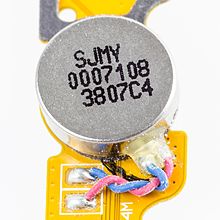
Vibramotor of LG Optimus L7 2
Tactile haptic feedback is common in cellular devices. In near cases, this takes the grade of vibration response to touch. Tall Electronics uses a haptic feedback applied science named PulseTouch on many of their touch-screen auto navigation and stereo units.[47] The Nexus 1 features haptic feedback, according to their specifications.[48] Samsung first launched a phone with haptics in 2007.[49]
Surface haptics refers to the production of variable forces on a user'due south finger every bit it interacts with a surface such every bit a touchscreen. Tanvas[50] uses an electrostatic applied science[51] to control the in-plane forces experienced by a fingertip, as a programmable function of the finger's motion. The TPaD Tablet Projection uses an ultrasonic applied science to attune the apparent slipperiness of a glass touchscreen.[52]
In 2013, Apple tree Inc. was awarded the patent for a haptic feedback organisation that is suitable for multitouch surfaces. Apple tree'southward U.South. Patent for a "Method and apparatus for localization of haptic feedback" describes a arrangement where at least two actuators are positioned beneath a multitouch input device, providing vibratory feedback when a user makes contact with the unit.[53] Specifically, the patent provides for one actuator to induce a feedback vibration, while at least one other actuator uses its vibrations to localize the haptic experience by preventing the kickoff prepare of vibrations from propagating to other areas of the device. The patent gives the example of a "virtual keyboard," yet, it is besides noted that the invention can be applied to any multitouch interface.[54]
Neurorehabilitation [edit]
For individuals with upper limb motor dysfunction, robotic devices utilizing haptic feedback could be used for neurorehabilitation. Robotic devices, such every bit end-effectors, and both grounded and ungrounded exoskeletons take been designed to assist in restoring control over several muscle groups. Haptic feedback applied by these robotic devices helps in the recovery of sensory function due to its more immersive nature.[55]
Puzzles [edit]
Haptic puzzles [56] [57] have been devised in guild to investigate goal-oriented haptic exploration, search, learning and memory in complex 3D environments. The goal is to both enable multi-fingered robots with a sense of touch, and gain more insights into human meta-learning.
Personal computers [edit]
In 2008, Apple tree Inc.'s MacBook and MacBook Pro started incorporating a "Tactile Touchpad" design[58] [59] with button functionality and haptic feedback incorporated into the tracking surface.[60] Products such as the Synaptics ClickPad followed.[61]
In 2015, Apple introduced "Forcefulness Bear on" trackpads onto the 2015 MacBook Pro which simulates clicks with a "Taptic Engine".[62] [63]
Robotics [edit]
Haptic feedback is essential to perform complex tasks via telepresence. The Shadow Paw, an avant-garde robotic manus, has a total of 129 bear upon sensors embedded in every joint and finger pad that relay information to the operator. This allows tasks such as typing to be performed from a altitude.[64] An early epitome can be seen in NASA'south drove of humanoid robots, or robonauts.[65]
Sensory substitution [edit]
In December 2015 David Eagleman demonstrated a article of clothing vest that "translates" speech and other audio signals into series of vibrations,[66] this allowed hear-impaired people to "experience" sounds on their body, information technology has since been made commercially as a wristband.[67]
Infinite [edit]
The utilise of haptic technologies may be useful in space exploration, including visits to the planet Mars, according to news reports.[68]
Tactile electronic displays [edit]
A tactile electronic display is a display device that delivers text and graphical information using the sense of touch. Devices of this kind have been adult to assist blind or deaf users by providing an alternative to visual or auditory sensation.[69] [70]
Teleoperators and simulators [edit]
Teleoperators are remote controlled robotic tools. When the operator is given feedback on the forces involved, this is called haptic teleoperation. The outset electrically actuated teleoperators were built in the 1950s at the Argonne National Laboratory by Raymond Goertz to remotely handle radioactive substances.[71] Since then, the utilise of force feedback has become more than widespread in other kinds of teleoperators, such equally remote-controlled underwater exploration devices.
Devices such every bit medical simulators and flight simulators ideally provide the force feedback that would be felt in real life. Simulated forces are generated using haptic operator controls, allowing data representing touch sensations to exist saved or played back.[72]
Teledildonics [edit]
Haptic feedback is used within teledildonics, or "sex activity-technology," in order to remotely connect sex toys and permit users to engage in virtual sexual practice or permit a remote server to control their sex toy. The term was first coined by Ted Nelson in 1975, when discussing the future of love, intimacy and technology.[ citation needed ] In recent years, teledildonics and sexual activity-engineering science accept expanded to include toys with a two-way connection that let virtual sex through the communication of vibrations, pressures and sensations. Many "smart" vibrators permit for a one-way connection either between the user, or a remote partner, to allow control of the toy.
Video games [edit]

Rumble packs for controllers, such equally this Dreamcast Bound Pack, provide haptic feedback through users' hands
Haptic feedback is commonly used in arcade games, especially racing video games. In 1976, Worm Odyssey, for the SNES was the first game to utilise haptic feedback, causing the handlebars to vibrate during a collision with some other worm.[73] Tatsumi's TX-i introduced force feedback to car driving games in 1983.[74] The game Earthshaker! added haptic feedback to a pinball motorcar in 1989.
Simple haptic devices are mutual in the form of game controllers, joysticks, and steering wheels. Early implementations were provided through optional components, such every bit the Nintendo 64 controller's Rumble Pak in 1997. In the aforementioned twelvemonth, the Microsoft SideWinder Force Feedback Pro with built-in feedback was released past Immersion Corporation.[75] Many console controllers and joysticks feature built-in feedback devices, which are motors with unbalanced weights that spin, causing it to vibrate, including Sony'south DualShock technology and Microsoft'south Impulse Trigger technology. Some automobile steering bicycle controllers, for example, are programmed to provide a "feel" of the road. Equally the user makes a turn or accelerates, the steering cycle responds by resisting turns or slipping out of control.
Notable introductions include:
- 2013: Steam Machines microconsoles by Valve, including a new Steam Controller unit of measurement that uses weighted electromagnets capable of delivering a wide range of haptic feedback via the unit's trackpads.[76] These controllers' feedback systems are user-configurable. Also in 2013 the get-go directly-drive wheel for sim racing was introduced.
- 2014: A new type of haptic absorber that responds to multimedia inputs by LG Electronics.[77]
- 2015: The Steam Controller with Hd Haptics, with haptic force actuators on both sides of the controller, by Valve.[78]
- 2017: The Nintendo Switch's Joy-Con introduced the Hard disk drive Rumble feature, developed with Immersion Corporation and using Alps actuators.[79] [eighty] [81]
- 2018: The Razer Nari Ultimate, gaming headphones using a pair of wide frequency haptic drivers, adult past Lofelt.[82] [83]
- 2020: The Sony PlayStation 5 controllers can adapt the resistance of the trigger controls, such equally simulating the increasing resistance felt while drawing the string of a bow, too as more precise haptic feedback through voice coil actuators.[84]
Virtual reality [edit]
Haptics are gaining widespread acceptance as a primal part of virtual reality systems, adding the sense of bear upon to previously visual-only interfaces.[85] Systems are being adult to apply haptic interfaces for 3D modeling and design, including systems that allow holograms to be both seen and felt.[86] [87] [88] Several companies are making full-body or torso haptic vests or haptic suits for use in immersive virtual reality to allow users to feel explosions and bullet impacts.[89]
See besides [edit]
- Haptic perception
- Haptics
- Linkage (mechanical)
- List of PC games with force feedback support
- Organic user interface
- Stylus (calculating)
- Tactile imaging
- Wired glove
References [edit]
- ^ "Augmented Reality" (PDF). Zums.ac.ir . Retrieved 19 April 2019.
- ^ Biswas, Southward.; Visell, Y. (2019). "Emerging Material Technologies for Haptics". Advanced Materials Technologies. 4 (4): 1900042. doi:10.1002/admt.201900042. S2CID 116269522.
- ^ Gabriel Robles-De-La-Torre. "International Society for Haptics: Haptic technology, an animated explanation". Isfh.org. Archived from the original on 2010-03-07. Retrieved 2010-02-26 .
- ^ Biswas, S.; Visell, Y. (2021). "Haptic Perception, Mechanics, and Material Technologies for Virtual Reality". Advanced Functional Materials. 31 (39): 2008186. doi:10.1002/adfm.202008186. S2CID 233893051.
- ^ Srinivasan, G.A.; LaMotte, R.H. (1995). "Tactual discrimination of softness". Journal of Neurophysiology. 73 (i): 88–101. doi:10.1152/jn.1995.73.one.88. PMID 7714593.
- ^ Freyberger, F.Thousand.B. & Färber, B. (2006). "Compliance bigotry of deformable objects by squeezing with ane and two fingers". Proceedings of EuroHaptics (pp. 271–76).
- ^ Bergmann Tiest, Due west.1000.; Kappers, A.M.L. (2009a). "Cues for haptic perception of compliance" (PDF). IEEE Transactions on Haptics. ii (4): 189–99. doi:10.1109/toh.2009.16. hdl:1874/40079. PMID 27788104. S2CID 5718866.
- ^ Tiest, Due west.Grand. (2010). "Tactual perception of material properties". Vision Res. 50 (24): 2775–82. doi:x.1016/j.visres.2010.x.005. hdl:1874/204059. PMID 20937297. S2CID 781594.
- ^ Loftin, Lawrence M, Jr. (1985). "Quest for Operation: The Evolution of Modernistic Aircraft" (PDF). NASA Scientific and Technical Data Branch. pp. Chapter 10. Retrieved 2019-07-19 .
- ^ Morosi, Federico; Rossoni, Marco; Caruso, Giandomenico (2019). "Coordinated control prototype for hydraulic excavator with haptic device". Automation in Construction. 105: 102848. doi:10.1016/j.autcon.2019.102848. S2CID 191138728.
- ^ Bach-Y-Rita, Paul; Collins, Carter C.; Saunders, Frank A.; White, Benjamin; Scadden, Lawrence (1969). "Vision Commutation by Tactile Prototype Projection". Nature. 221 (5184): 963–964. Bibcode:1969Natur.221..963B. doi:10.1038/221963a0. ISSN 1476-4687. PMID 5818337. S2CID 4179427.
- ^ "Patent US3780225 – Tactile communication attachment". USPTO. eighteen December 1973. Retrieved 29 December 2015.
- ^ "Human-Machine Tactile Communication," SID Journal, Vol. one, No. two, (July/Baronial 1972), pp. v–11.
- ^ "US Patent 3919691 – Tactile man-auto communication organisation". USPTO. xi Nov 1975. Retrieved 29 December 2015.
- ^ Chen, Howard Henry. "Electronic vest adds a chest full of thrills to video games". baltimoresun.com . Retrieved 2019-07-19 .
- ^ 5587937, Massie, Thomas H. & Salisbury, Jr, "United States Patent: 5587937 - Force reflecting haptic interface", issued December 24, 1996
- ^ "Apple-klokka ble egentlig designet i Norge for xx år siden". Teknisk Ukeblad digi.no. (Norwegian language). 30 March 2015.
- ^ Fagiani, R., & Barbieri, M. (2016). A contact mechanics estimation of the duplex theory of tactile texture perception. Tribology International, 101, 49-58.
- ^ Scheibert, J., Leurent, S., Prevost, A., & Debrégeas, One thousand. (2009). The role of fingerprints in the coding of tactile information probed with a biomimetic sensor. Science, 323(5920), 1503-1506.
- ^ Ye, Shen (2015-04-08). "The scientific discipline behind Forcefulness Touch and the Taptic Engine". iMore . Retrieved 2019-07-19 .
- ^ Texas Instruments (2017). "Hear and feel the difference: TI'south depression-power audio and activators" (PDF). Texas Instruments . Retrieved 2019-07-xix .
- ^ Abeer Bayousuf, Hend S. Al-Khalifa, Abdulmalik Al-Salman (2017) Haptics-Based Systems Characteristics, Nomenclature, and Applications, p.4658, in Khosrow-Pour, D.B.A., Mehdi (Eds., 2017) Encyclopedia of Informatics and Technology, 4th Edition, Affiliate 404, pages 4652-4665
- ^ Wood, Tina (2007-04-05). "Introducing the Novint Falcon". On10.internet. Archived from the original on 2010-06-20. Retrieved 2010-02-26 .
- ^ "Devices". HapticDevices. Archived from the original on 10 September 2013. Retrieved 22 September 2013.
- ^ Gupta, Sidhant; Morris, Dan; Patel, Shwetak Due north.; Tan, Desney (2013-01-01). "AirWave: Non-contact Haptic Feedback Using Air Vortex Rings". Proceedings of the 2013 ACM International Articulation Briefing on Pervasive and Ubiquitous Computing. UbiComp 'thirteen. New York: ACM: 419–28. doi:10.1145/2493432.2493463. ISBN978-1-4503-1770-2. S2CID 1749365.
- ^ Sodhi, Rajinder; Poupyrev, Ivan; Glisson, Matthew; Israr, Ali (2013-07-01). "AIREAL: Interactive Tactile Experiences in Free Air". ACM Trans. Graph. 32 (4): 134:1–x. doi:10.1145/2461912.2462007. ISSN 0730-0301. S2CID 5798443.
- ^ Shtarbanov, Ali; Bove Jr., V. Michael (2018). "Free-Space Haptic Feedback for 3D Displays via Air-Vortex Rings" (PDF). Extended Abstracts of the 2018 CHI Briefing on Man Factors in Calculating Systems - CHI '18. Montreal QC, Canada: ACM Press: 1–6. doi:10.1145/3170427.3188622. ISBN9781450356213. S2CID 5049106.
- ^ Culbertson, Heather; Schorr, Samuel B.; Okamura, Allison G. (2018). "Haptics: The Present and Future of Artificial Touch Sensation". Annual Review of Control, Robotics, and Autonomous Systems. 1 (1): 385–409. doi:10.1146/annurev-control-060117-105043. S2CID 64963235.
- ^ Long, Benjamin (Nov 19, 2014). "Rendering volumetric haptic shapes in mid-air using ultrasound: Proceedings of ACM SIGGRAPH Asia 2014". ACM Transactions on Graphics. 33: 6. doi:10.1145/2661229.2661257. S2CID 3467880.
- ^ Basdogan, C.; Giraud, F.; Levesque, 5.; Choi, S. A Review of Surface Haptics: Enabling Tactile Effects on Touch on Surfaces. IEEE Transactions on Haptics. Institute of Electric and Electronics Engineers July 1, 2020, pp 450–470.
- ^ Scheibert, J., Leurent, S., Prevost, A., & Debrégeas, G. (2009). The part of fingerprints in the coding of tactile information probed with a biomimetic sensor. Science, 323(5920), 1503-1506.
- ^ Breitschaft, Stefan Josef; Clarke, Stella; Carbon, Claus-Christian (26 July 2019). "A Theoretical Framework of Haptic Processing in Automotive User Interfaces and Its Implications on Design and Engineering". Frontiers in Psychology. 10: 1470. doi:10.3389/fpsyg.2019.01470. PMC6676796. PMID 31402879.
- ^ Kern, Dagmar; Pfleging, Bastian. "Supporting Interaction Through Haptic Feedback in Automotive User Interfaces" (PDF). Section for Information science, Academy of Munich. Retrieved 25 October 2019.
- ^ Sommerer, Christa; Mignonneau, Laurent (1999-06-01). "Fine art every bit a Living System: Interactive Reckoner Artworks". Leonardo. 32 (three): 165–173. doi:10.1162/002409499553190. ISSN 0024-094X. S2CID 57569436.
- ^ Davis, Nicola (2015-08-22). "Don't but look – smell, feel, and hear fine art. Tate's new way of experiencing paintings". The Observer. ISSN 0029-7712. Retrieved 2019-07-twenty .
- ^ Inglis, Sam. "SynthFest UK — Teenage Applied science OP-Z Rumble Pack". www.soundonsound.com . Retrieved 24 Oct 2019.
- ^ Florian J. J. Schmidt-Skipiol & Peter Hecker (2015). "Tactile Feedback and Situation Awareness-Improving Adherence to an Envelope in Sidestick-Controlled Fly-by-Wire Aircrafts [sic]". 15th AIAA Aviation Technology, Integration, and Operations Conference: 2905. doi:10.2514/6.2015-2905.
- ^ Jacobus, C., et al., Method and system for simulating medical procedures including virtual reality and command method and system, US Patent 5,769,640
- ^ Pinzon D, Byrns S, Zheng B. "Prevailing Trends in Haptic Feedback Simulation for Minimally Invasive Surgery". Surgical Innovation. 2016 Feb.
- ^ Martin, Nicolas; Maddock, Stephen; Stokes, Christopher; Field, James; Towers, Ashley (2019). "A scoping review of the utilize and application of virtual reality in pre-clinical dental educational activity" (PDF). British Dental Journal. 226 (5): 358–366. doi:ten.1038/s41415-019-0041-0. ISSN 1476-5373. PMID 30850794. S2CID 71716319.
- ^ "Honors And Awards". Ent. ohiou.edu. Archived from the original on Apr 2, 2008. Retrieved 2010-02-26 .
- ^ Kapoor, Shalini; Arora, Pallak; Kapoor, Vikas; Jayachandran, Mahesh; Tiwari, Manish (2017-05-17). "Haptics – Touchfeedback Engineering science Widening the Horizon of Medicine". Journal of Clinical and Diagnostic Research. eight (3): 294–99. doi:10.7860/JCDR/2014/7814.4191. ISSN 2249-782X. PMC4003673. PMID 24783164.
- ^ Russ, Zajtchuk (2008-09-15). "Telepresence Surgery". Archived from the original on 2008-09-fifteen. Retrieved 2017-05-17 .
- ^ Attila A Priplata, James B Niemi, Jason D Harry, Lewis A Lipsitz, James J Collins. "Vibrating insoles and balance control in elderly people" Archived 2012-06-10 at the Wayback Machine The Lancet, Vol 362, Oct four, 2003.
- ^ Gardner, Julie (2014-12-10). "Vibrating Insoles May Improve Residuum in Seniors". CBS Boston . Retrieved 2019-07-20 .
- ^ "Arizona Vet School Installs Haptic Cow, Horse". Veterinary Practice News. 2015-09-29. Retrieved 2022-01-13 .
- ^ "Alpine Electronics Ships New IVA-W205 Double-DIN Sound/Vide + Naviation Head Unit of measurement". Torrance, CA. May 8, 2007. Archived from the original on November 17, 2008. Retrieved 2009-12-15 .
- ^ "What's With Tech? –Technology Guide For Dummies". whatswithtech.com. Archived from the original on 2015-04-02. Retrieved 2017-05-17 .
- ^ "Mobile Phones to Get Tactile Touch Screens". TechHive. 26 June 2006. Retrieved 2015-x-07 .
- ^ Rediscover Touch. Tanvas, Inc. website. retrieved 2016-06-05
- ^ "Finger on Electrostatic Touchscreen in Irksome Movement." YouTube video retrieved 2016-06-05
- ^ "TPaD Tablet Projection website." retrieved 2016-06-05
- ^ Pance, Alioshin & Bilbrey, Aleksandar & Paul, Brett (February 19, 2013). "United States Patent: 8378797 – Method and apparatus for localization of haptic feedback". Retrieved 2017-05-17 .
{{cite spider web}}: CS1 maint: multiple names: authors list (link) - ^ Campbell, Mikey (2013-02-19). "Apple awarded patent for more accurate haptic feedback system". Apple Insider . Retrieved three April 2013.
- ^ Piggott, Leah, Samantha Wagner, and Mounia Ziat. "Haptic neurorehabilitation and virtual reality for upper limb paralysis: A review." Critical Reviews™ in Biomedical Engineering 44.1-2 (2016).
- ^ "Haptic Puzzles with Modular Haptic Stimulus Board (MHSB)".
- ^ "Search Procedures during Haptic Search in an Unstructured 3D Display, A. Moringen, R. Haschke, H. Ritter". doi:10.1109/HAPTICS.2016.7463176. S2CID 4135569.
- ^ "The Tactile Touchpad". CHI 97 Electronic Publications. Archived from the original on 2011-ten-01. Retrieved 2011-03-24 .
- ^ I. Scott, MacKenzie (April 23, 1998). "A Comparing of Three Selection Techniques for Touchpads" (PDF). CHI 98.
- ^ "MacBook design". Apple.com. Archived from the original on 2011-03-21. Retrieved 2017-09-09 .
- ^ "ClickPad". Synaptics.com. Archived from the original on 2011-02-18.
- ^ "Apple's 'Strength Affect' Trackpad Fools Users Into Feeling Clicks Without Actually Moving". Retrieved 2017-eleven-22 .
- ^ "The MacBook Pro's new Forcefulness Touch Trackpad is great. Pity about the name". The Verge . Retrieved 2017-11-22 .
- ^ Dormehl, Luke (2019-04-27). "The holy grail of robotics: Within the quest to build a mechanical human mitt". Digital Trends . Retrieved 2019-07-20 .
- ^ "Robonaut". Robonaut.jsc.nasa.gov. Retrieved 2010-02-26 .
- ^ "This vibrating vest is giving deaf people a sixth sense". Wired U.k.. ISSN 1357-0978. Retrieved 2021-08-24 .
- ^ "Feeling Sound as Vibration: A Review of the Neosensory Buzz". Hearing Health & Technology Matters. 2020-09-04. Retrieved 2021-08-24 .
- ^ Von Drehle, David (15 December 2020). "Humans don't have to set foot on Mars to visit it". The Washington Mail . Retrieved sixteen December 2020.
- ^ Chouvardas, V.K.; Miliou, A.N.; Hatalis, M.Chiliad. (2008). "Tactile displays: Overview and contempo advances" (PDF). Displays. 29 (iii): 185–194. CiteSeerX10.one.1.180.3710. doi:ten.1016/j.displa.2007.07.003.
- ^ "Here's What the Future of Haptic Technology Looks (Or Rather, Feels) Like". Smithsonian . Retrieved 2019-07-20 .
- ^ Goertz, R.C. (1952-11-01). "Fundamentals of full general purpose remote manipulators". Nucleonics. 10: 36–42.
- ^ Feyzabadi, Southward.; Straube, S.; Folgheraiter, M.; Kirchner, Eastward.A.; Su Kyoung Kim; Albiez, J.C., "Homo Forcefulness Discrimination during Active Arm Motion for Forcefulness Feedback Design," IEEE Transactions on Haptics, vol. half dozen, no. 3, pp. 309, 319, July–Sept. 2013
- ^ Mark J.P. Wolf (2008), The video game explosion: a history from PONG to PlayStation and beyond, p. 39, ABC-CLIO, ISBN 0-313-33868-10
- ^ TX-1 at the Killer List of Videogames
- ^ "Microsoft and Immersion Go on Joint Efforts To Advance Time to come Development of Force Feedback Applied science". Stories. 3 Feb 1998.
- ^ Webster, Andrew (September 27, 2013). "Valve unveils the Steam Controller". The Verge. Retrieved September 27, 2013.
- ^ Y. J., Cho. "Haptic Absorber: Automatic Generation of Vibro-tactile Feedback Based on Audio Signal for Immersive Interaction with Multimedia". Research Gate. LG Electronics.
- ^ Neal, Dave (2013-09-30). "Valve shows off the Steam controller with haptic feedback". The Inquirer. Archived from the original on September xxx, 2013. Retrieved 2019-07-20 .
{{cite spider web}}: CS1 maint: unfit URL (link) - ^ "Nintendo's Hard disk drive Rumble will be the best unused Switch characteristic of 2017". Engadget . Retrieved 2017-05-17 .
- ^ Porter, Jon (vii February 2017). "Meet the minds backside Nintendo Switch'southward Hd Rumble tech". TechRadar . Retrieved fifteen November 2019.
- ^ Hall, Charlie (5 Apr 2017). "Japanese site estimates Nintendo spends $257 to make one Switch". Polygon . Retrieved 15 Nov 2019.
- ^ Andreadis, Kosta (2019-06-21). "Razer Nari Ultimate Wireless Gaming Headset Review - AusGamers.com". Ausgamers . Retrieved 2019-07-20 .
- ^ Summers, Nick. "Razer brings its vibrating Nari Ultimate headset to Xbox One". Engadget . Retrieved 15 Nov 2019.
- ^ Rubin, Peter. "Exclusive: A Deeper Wait at the PlayStation 5—Haptics, UI Facelift, and More". Wired . Retrieved 24 October 2019.
- ^ Moren, Dan (2015-04-27). "Haptic Gloves Use Air Pressure To Simulate The Feel Of Virtual Objects". Popular Science . Retrieved 2019-07-20 .
- ^ Jeffrey, Colin (2014-12-02). "New ultrasound research creates holographic objects that can be seen and felt". New Atlas . Retrieved 2019-07-xx .
- ^ "Touchable Hologram Becomes Reality (west/ Video)". Physorg.com. 2009-08-06. Retrieved 2010-02-26 .
- ^ Mary-Ann Russon (2016). Holograms you lot can achieve out and affect developed by Japanese scientists. IBTimes
- ^ Moss, Richard (2015-01-xv). "Haptic applied science: The side by side frontier in video games, wearables, virtual reality, and mobile electronics". New Atlas . Retrieved 2019-07-20 .
Farther reading [edit]
- Klein, D.D.; Rensink, H.; Freimuth, K.J.; Monkman, S.; Egersdörfer, H.; Böse & M. Baumann. Modelling the Response of a Tactile Assortment using Electrorheological Fluids. Journal of Physics D: Applied Physics, Vol. 37, No. five, pp. 794–803, 2004.
- Klein, D.H.; Freimuth, G.J.; Monkman, Due south.; Egersdörfer, A.; Meier, H.; Böse Grand.; Baumann, H;, Ermert & O. T. Bruhns. "Electrorheological Tactile Elements". Mechatronics Vol. 15, No. vii, pp. 883–97. Pergamon, September 2005.
- Monkman. G.J. "An Electrorheological Tactile Display". Presence (Journal of Teleoperators and Virtual Environments) Vol. 1, No. 2, pp. 219–28, MIT Press, July 1992.
- Parisi, David. Archaeologies of Touch - Interfacing with Haptics from Electricity to Computing. Academy of Minnesota Press. ISBN 978-1-5179-0059-5.
- Robles-De-La-Torre Thou. Principles of Haptic Perception in Virtual Environments. In Grunwald One thousand (Ed.), Human being Haptic Perception, Birkhäuser Verlag, 2008.
- Vashisth, A.; Mudur, South. (2008). "Deforming point-based models using an electronic glove". Proceedings of the 2008 C3S2E Conference: 193. doi:10.1145/1370256.1370288. ISBN978-one-60558-101-9. S2CID 15769903.
External links [edit]
- Haptic applied science at HowStuffWorks
- What Vibration Frequency Is Best For Haptic Feedback?
Source: https://en.wikipedia.org/wiki/Haptic_technology
0 Response to "ââ⢠What Are Haptic and Optic Forms of Art?"
Post a Comment