Art Institute of Chicago Painting Girl Umbrella Stick Figure
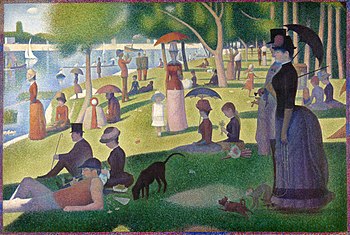
| A Sunday Afternoon on the Island of La Grande Jatte | |
|---|---|
 | |
| Artist | Georges Seurat |
| Twelvemonth | 1884–1886 |
| Medium | Oil on canvas |
| Discipline | People relaxing at la Grande Jatte, Paris |
| Dimensions | 207.6 cm × 308 cm (81.7 in × 121.25 in) |
| Location | Art Institute of Chicago |
A Dominicus Afternoon on the Isle of La Grande Jatte (French: United nations dimanche après-midi à l'Île de la Grande Jatte) was painted from 1884 to 1886 and is Georges Seurat's most famous work.[1] A leading instance of pointillist technique, executed on a large canvas, it is a founding work of the neo-impressionist motility. Seurat's composition includes a number of Parisians at a park on the banks of the River Seine. It is in the drove of the Art Found of Chicago.
Background [edit]
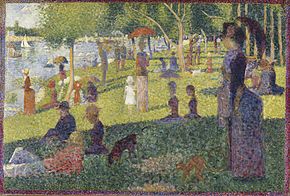
Georges Seurat, Written report for "A Sunday Afternoon on La Grande Jatte", 1884, oil on canvas, seventy.5 x 104.1 cm, Metropolitan Museum of Fine art, New York
In 1879, Georges Seurat enlisted equally a soldier in the French army and arrived back habitation in 1880. Later, he ran a pocket-size painter's studio in Paris, and in 1883 showed his work publicly for the first time. The post-obit year, Seurat began to piece of work on La Grande Jatte and exhibited the painting in the spring of 1886 with the Impressionists.[two] With La Grande Jatte, Seurat was immediately acknowledged equally the leader of a new and rebellious form of Impressionism called Neo-Impressionism.[3]
Seurat painted A Sunday Afternoon between May 1884 and March 1885, and from October 1885 to May 1886, focusing meticulously on the landscape of the park.[4] He reworked the original and completed numerous preliminary drawings and oil sketches. He saturday in the park, creating numerous sketches of the various figures in order to perfect their form. He concentrated on issues of colour, light, and form. The painting is approximately 2 by 3 metres (6.6 ft × 9.eight ft) in size.
Inspired by optical effects and perception inherent in the color theories of Michel Eugène Chevreul, Ogden Rood and others, Seurat adapted this scientific inquiry to his painting.[v] Seurat contrasted miniature dots or small brushstrokes of colors that when unified optically in the human eye were perceived as a single shade or hue. He believed that this form of painting, called Divisionism at the fourth dimension (a term he preferred)[6] but now known as Pointillism, would make the colors more brilliant and powerful than standard brushstrokes. The utilise of dots of almost uniform size came in the second yr of his work on the painting, 1885–86. To make the experience of the painting even more vivid, he surrounded it with a frame of painted dots, which in turn he enclosed with a pure white, wooden frame, which is how the painting is exhibited today at the Art Institute of Chicago.
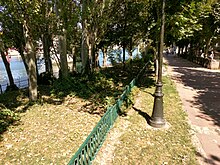
The Isle of la Grande Jatte is located at the very gates of Paris, lying in the Seine between Neuilly and Levallois-Perret, a short distance from where La Défense business district currently stands. Although for many years it was an industrial site, information technology is today the site of a public garden and a housing evolution. When Seurat began the painting in 1884, the island was a bucolic retreat far from the urban centre.
The painting was first exhibited at the eighth (and last) Impressionist exhibition in May 1886, then in Baronial 1886, dominating the second Salon of the Société des Artistes Indépendants, of which Seurat had been a founder in 1884.[1] Seurat was extremely disciplined, always serious, and individual to the point of secretiveness—for the nigh part, steering his own steady class. As a painter, he wanted to make a departure in the history of fine art and with La Grand Jatte, many say that he succeeded.[7]
Interpretation [edit]
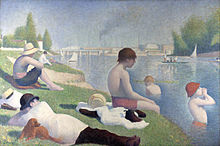
The left banking company of working course Bathers at Asnières (1884) mirrors the correct bank of the bourgeoisie on La Grande Jatte.
Seurat'southward painting was a mirror impression of his ain painting, Bathers at Asnières, completed shortly before, in 1884. Whereas the bathers in that earlier painting are doused in light, almost every figure on La Grande Jatte appears to be cast in shadow, either under copse or an umbrella, or from another person. For Parisians, Sunday was the day to escape the oestrus of the city and caput for the shade of the copse and the cool breezes that came off the river. And at first glance, the viewer sees many different people relaxing in a park by the river. On the correct, a fashionable couple, the adult female with the sunshade and the human in his top hat, are on a stroll. On the left, another woman who is also well dressed extends her fishing pole over the h2o. There is a modest man with the blackness hat and thin pikestaff looking at the river, and a white dog with a dark-brown head, a woman knitting, a man playing a trumpet, ii soldiers standing at attention as the musician plays, and a adult female hunched under an orange umbrella. Seurat also painted a man with a pipe, a woman under a parasol in a gunkhole filled with rowers, and a couple admiring their infant kid.[8]
Some of the characters are doing curious things. The lady on the right side has a monkey on a leash. A lady on the left near the river bank is fishing. The expanse was known at the time equally existence a place to procure prostitutes among the bourgeoisie, a likely allusion of the otherwise odd "fishing" rod. In the painting's eye stands a little girl dressed in white (who is not in a shadow), who stares directly at the viewer of the painting. This may be interpreted as someone who is silently questioning the audience: "What will become of these people and their class?" Seurat paints their prospects bleakly, cloaked equally they are in shadow and suspicion of sin.[9]
In the 1950s, historian and Marxist philosopher Ernst Bloch drew social and political significance from Seurat's La Grande Jatte. The historian'south focal point was Seurat'southward mechanical use of the figures and what their static nature said about French gild at the time. Afterward, the work received heavy criticism by many that centered on the artist's mathematical and robotic interpretation of modernity in Paris.[8]

According to historian of Modernism William R. Everdell:
Seurat himself told a sympathetic critic, Gustave Kahn, that his model was the Panathenaic procession in the Parthenon frieze. Merely Seurat didn't want to pigment ancient Athenians. He wanted 'to brand the moderns file past ... in their essential form.' By 'moderns' he meant nothing very complicated. He wanted ordinary people every bit his bailiwick, and ordinary life. He was a chip of a democrat—a "Communard," every bit 1 of his friends remarked, referring to the left-fly revolutionaries of 1871; and he was fascinated by the way things distinct and different encountered each other: the urban center and the country, the farm and the manufacturing plant, the bourgeois and the proletarian meeting at their edges in a sort of harmony of opposites.[10]
The border of the painting is, unusually, in inverted color, every bit if the globe around them is also slowly inverting from the way of life they have known. Seen in this context, the boy who bathes on the other side of the river bank at Asnières appears to exist calling out to them, as if to say, "We are the future. Come up and join united states of america".[9]
Painting materials [edit]
Seurat painted the La Grande Jatte in three singled-out stages.[11] In the first stage, which was started in 1884, Seurat mixed his paints from several private pigments and was even so using dull earth pigments such as ochre or burnt sienna. In the second stage, during 1885 and 1886, Seurat dispensed with the earth pigments and besides limited the number of private pigments in his paints. This modify in Seurat's palette was due to his application of the advanced color theories of his time. His intention was to pigment small dots or strokes of pure color that would and then mix on the retina of the beholder to attain the desired color impression instead of the usual exercise of mixing individual pigments.
Seurat'south palette consisted of the usual pigments of his time such as cobalt blue, emerald light-green and vermilion.[12] [13] Additionally, Seurat used then new pigment zinc xanthous (zinc chromate), predominantly for yellowish highlights in the sunlit grass in the eye of the painting but also in mixtures with orange and blueish pigments. In the century and more than since the painting's completion, the zinc yellow has darkened to brownish—a color degeneration that was already showing in the painting in Seurat's lifetime.[14] The discoloration of the originally bright yellowish zinc yellow (zinc chromate) to brownish color is due to the chemical reaction of the chromate ions to orangish-colored dichromate ions.[15] In the tertiary stage during 1888–89 Seurat added the colored borders to his composition.
The results of investigation into the discoloration of this painting have been combined with further enquiry into natural aging of paints to digitally rejuvenate the painting.[xvi]
Conquering past the Fine art Plant of Chicago [edit]
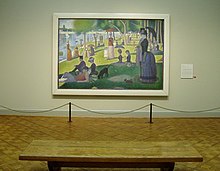
On display at the Art Institute of Chicago
In 1923, Frederic Bartlett was appointed trustee of the Fine art Constitute of Chicago. He and his second wife, Helen Birch Bartlett, loaned their collection of French Mail-Impressionist and Modernist art to the museum. It was Mrs. Bartlett who had an interest in French and advanced artists and influenced her husband's collecting tastes. Sunday Afternoon on the Island of La Grande Jatte was purchased on the advice of the Art Institute of Chicago'southward curatorial staff in 1924.[17]
In conceptual artist Don Celender'southward 1974–75 book Observation and Scholarship Examination for Art Historians, Museum Directors, Artists, Dealers and Collectors, it is claimed that the institute paid $24,000 for the piece of work[17] [18] (over $354,000 in 2018 dollars[19]).
In 1958, the painting was loaned for the only time: to the Museum of Modern Art in New York. On 15 Apr 1958, a fire in that location, which killed 1 person on the second flooring of the museum, forced the evacuation of the painting, which had been on a floor above the fire, to the Whitney Museum, which adjoined MoMA at the time.[20]
In pop civilization [edit]
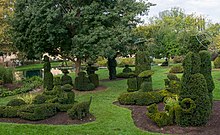
Topiary Park in Columbus, Ohio, replicates much of the painting
The May 1976 consequence of Playboy featured Nancy Cameron—Playmate of the Month in January 1974—on its embrace, superimposed on the painting in similar mode. The oftentimes hidden bunny logo was bearded equally one of the millions of dots.[21]
The painting is the basis for the 1984 Broadway musical Lord's day in the Park with George by Stephen Sondheim and James Lapine, which tells a fictionalized story of the painting's creation. Later on, the painting is sometimes referred to by the misnomer "Sunday in the Park".
The painting is prominently featured in the 1986 comedy motion-picture show Ferris Bueller's Day Off, in a scene later parodied, among others, in Looney Tunes: Back in Activity, Family Guy, and Muppet Babies.[ citation needed ]
In the Simpsons episode "Mom and Pop Art" (10x19), Barney Gumble offers to pay for a beer with a handmade reproduction of the painting. The painting is also parodied in the picnic scene at the end of the episode "Super Franchise Me" (26x3).
In Topiary Park (formerly Old Deaf School Park) in Columbus, Ohio, sculptor James T. Stonemason re-created the painting in topiary grade; the installation was completed in 1989.[22]
The painting was the inspiration for a commemorative affiche printed for the 1993 Detroit Belle Isle Thousand Prix, with racing cars and the Detroit skyline added.
In 2011, the bandage of the US version of The Role re-created the painting for a affiche to promote the show's seventh-season finale.[23]
The comprehend photograph of the June 2014 edition of San Francisco magazine, "The Oakland Issue: Special Edition", features a scene on the shore of Lake Merritt that re-creates the poses of the figures in Seurat's painting.[24]
The painting is featured in the Creature Crossing video game series as a purchasable article of furniture particular under the proper name the "Calm Painting".
On the 2nd of December 2021, the painting was used as function of an hommage to Georges Seurat by Google in one of its doodles.[25]
[edit]
| External video | |
|---|---|
 Georges Seurat, A Lord's day on La Grande Jatte – 1884, 1884–86, Smarthistory.[26] Georges Seurat, A Lord's day on La Grande Jatte – 1884, 1884–86, Smarthistory.[26] |
-
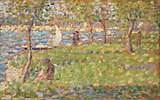
Study for La M Jatte
-
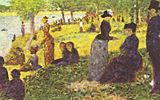
Die Insel La Grande Jatte mit Ausflüglern, 1884
-

Paysage et personnages, 1884–85
-

Groupe de personnages, 1884–85
-

Esquisse d'ensemble, 1884–85
-

Femmes au bord de 50'eau, 1885–86
-

Models (Les Poseuses) 1886-1888
Run across also [edit]
- 100 Smashing Paintings
References [edit]
- ^ a b Seurat, Georges. "A Sunday on La Grande Jatte — 1884". The Fine art Institute of Chicago . Retrieved 17 May 2021.
- ^ Clayton, Due south. Hollis (1996). Tomlinson, Janis (ed.). The Family and the Father: The 'Grand Jatte' and Its Absences . Readings in Nineteenth-Century Art. Prentice Hall. p. 212-213. ISBN978-0-1310-4142-4.
- ^ Chu, Petra ten-Doesschate (2012). Nineteenth-Century European Art (3rd ed.). Prentice Hall. pp. 414–417. ISBN978-0-1319-6269-9.
- ^ Dorra, Henri; Rewald, John (1959). Seurat: L'œuvre peint, Biographie et Catalogue Critique (in French). Paris: Les Beaux-Arts. p. 156.
- ^ Herbert, Robert (1968). Neo-Impressionism . New York: Solomon R. Guggenheim Foundation. p. 106.
- ^ Galitz, Kathryn Calley (2007). Masterpieces of European Painting, 1800–1920, in the Metropolitan Museum of Fine art. New York: Metropolitan Museum of Art. p. 177. ISBN978-1-58839-240-four.
- ^ Herbert, Robert L.; Neil Harris; Georges Seurat (2004). Seurat and the making of 'La Grande Jatte . Chicago: Art Institute of Chicago in association with the University of California Printing. ISBN978-0-5202-4210-4.
- ^ a b Burleigh, Robert (2004). Seurat and La Grande Jatte: connecting the dots . New York: Harry North. Abrams. ISBN978-0-8109-4811-ii . Retrieved 27 Nov 2021.
- ^ a b "Georges Seurat: A Lord's day Afternoon on the Isle of La Grande Jatte". The Private Life of a Masterpiece. Series 4. 2005. BBC Two.
- ^ Everdell, William R. (1997). The First Moderns: The Get-go Moderns: Profiles in the Origins of Twentieth Century Thought. Chicago: Academy of Chicago Press. p. 67. ISBN978-0-2262-2481-7 . Retrieved 27 Nov 2021.
- ^ Fiedler, Inge (2004). La Grande Jatte: A Written report of the Painting Materials. Seurat and the Making of La Grande Jatte. Academy of California. pp. 110–113.
- ^ Fiedler, Inge (1989). "A Technical Evaluation of the 'Grande Jatte'". Art Constitute of Chicago Museum Studies. fourteen (2): 173–179, 244–245. doi:10.2307/4108750. JSTOR 4108750.
- ^ "Georges Seurat, 'Sunday afternoon on La Grande Jatte'". ColourLex.
- ^ Gage, John (1993). Color and Civilization: Practice and Pregnant from Antiquity to Abstraction. Boston: Little, Brownish. pp. 220, 224. ISBN978-0-5202-2225-0.
- ^ Casadio, Francesca; Fiedler, Inge; Gray, Kimberly A.; Warta, Richard (2008). Bridgland, Janet (ed.). "Deterioration of zinc potassium chromate pigments: elucidating the effects of paint composition and environmental conditions on chromatic amending". 15th Triennial Briefing Preprints, New Delhi, 22–26 September 2008. Paris: International Council of Museums: 572–580. ISBN9788184243468.
- ^ Berns, Roy S. (2006). "Rejuvenating the colour palette of Georges Seurat's A Lord's day on La Grande Jatte—1884: A simulation". Color Research & Application. 31 (4): 278–293. doi:10.1002/col.20223.
- ^ a b "The Art Institute of Chicago, A Lord's day on La Grande Jatte, 1884". Archived from the original on twenty September 2016. Retrieved 10 May 2012.
- ^ Celender, Don (1974–75). Observation and Scholarship Exam for Art Historians, Museum Directors, Artists, Dealers, and Collectors. Publication was produced for an exhibition held at the O.K. Harris Gallery, 383 West Broadway, New York, from 7 to 28 December 1974. pp. Question: Page 5, Answer: Page 23.
- ^ "CPI Inflation Reckoner". Archived from the original on 4 August 2016. Retrieved iii November 2013.
- ^ Kihss, Peter (16 Apr 1958). "Fire in Modern Museum; Near Fine art Safety; vi Canvases Burned, Seurat'due south Removed". The New York Times. p. 1.
- ^ "Stagerism Alarm: Seurat". Lucass Pivey. 7 March 2010. Archived from the original on 28 June 2013. Retrieved 27 November 2021.
- ^ "The Topiary Park: A Unique Interpretation of a Painting". The Topiary Park. Archived from the original on xx October 2013.
- ^ Hibbert, James (16 May 2011). "First Look: NBC's amazing new 'The Office' poster". Entertainment Weekly. Archived from the original on 26 October 2015. Retrieved 27 November 2021.
- ^ "The Oakland Consequence". San Francisco. June 2014. Archived from the original on 26 February 2015. Retrieved 26 February 2015.
- ^ "Google rend hommage ce jeudi à ce maître de la peinture : qui était Georges Seurat". Sud Ouest. December 2021.
- ^ "Seurat, A Sunday on La Grande Jatte". Smarthistory at Khan University . Retrieved 23 Apr 2016.
Further reading [edit]
- Herbert, Robert L.; Robert Herbert; Georges Seurat; Gary Tinterow; Françoise Cachin; Anne Distel; Susan Alyson Stein (1991). O'Neill, J (ed.). Georges Seurat, 1859–1891. New York: The Metropolitan Museum of Art. ISBN978-0-8109-6410-5.
- William R. Everdell, The Start Moderns: Profiles in the Origins of Twentieth Century Idea (Chicago: University of Chicago Press).
- "Firey Peril in a Showcase of Modern Fine art". Life. 28 April 1958. pp. 53–55.
External links [edit]
- Seurat and the Making of La Grande Jatte
- La Grande Jatte – Inspiration, Analysis and Disquisitional Reception
- A Sunday on La Grande Jatte — 1884 at The Art Constitute of Chicago
- Georges Seurat, 1859–1891, MoMA exhibition catalog
- Georges Seurat, Sunday Afternoon at La Grande Jatte, ColourLex
- Roch, Christine Fifty. "From "Rube Town" to Modernistic City". Archived from the original on 15 October 2012. Retrieved iv August 2011.
Source: https://en.wikipedia.org/wiki/A_Sunday_Afternoon_on_the_Island_of_La_Grande_Jatte
0 Response to "Art Institute of Chicago Painting Girl Umbrella Stick Figure"
Post a Comment